AI & 3D · 7 min read
How AI Can Help 3D Artisans—Without Replacing the Hand
AI is becoming a capable studio assistant for 3D creators. Its real value is not replacing craft, but expanding exploration while the artisan retains judgment, authorship, and control.
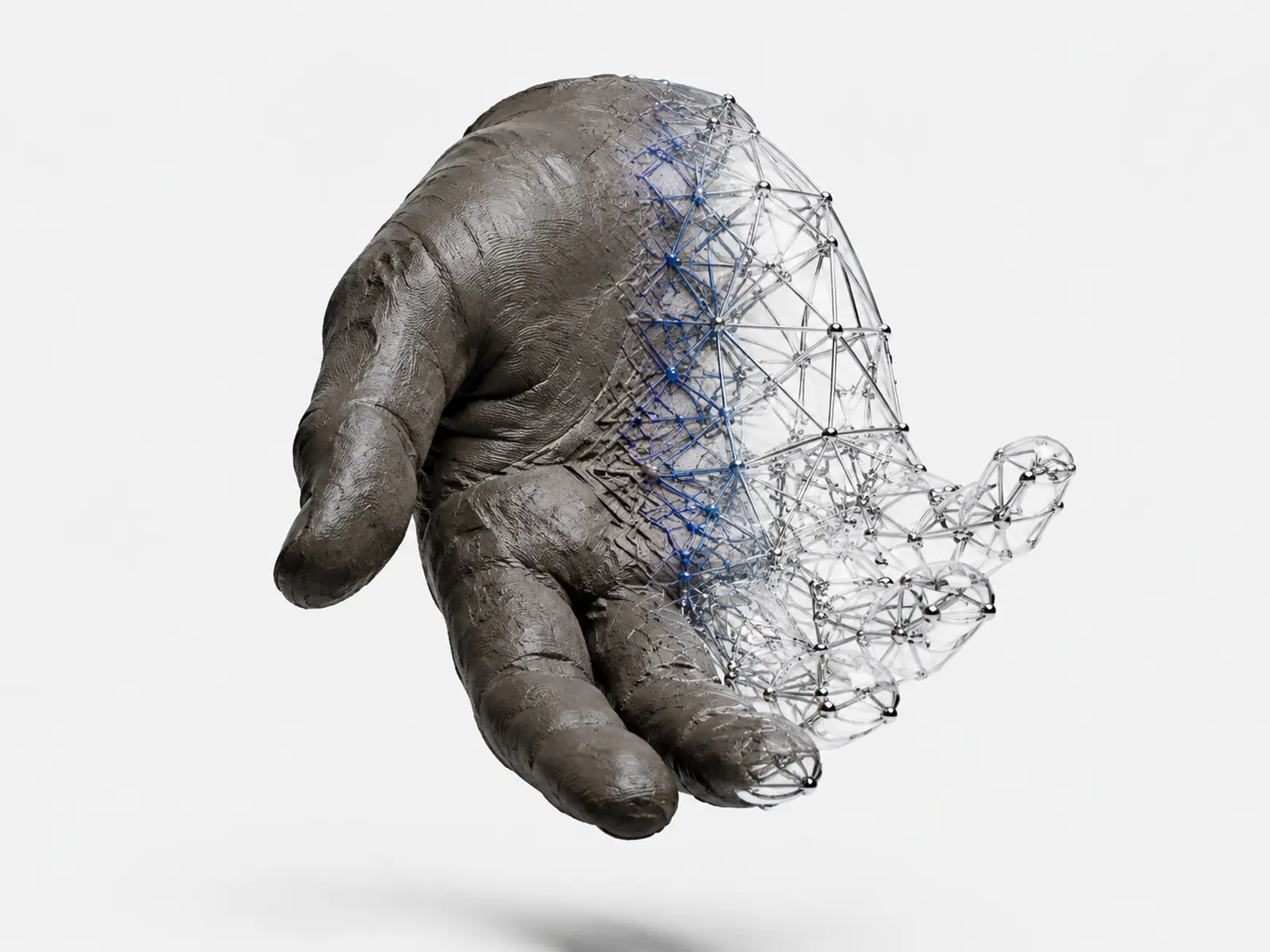
A 3D artisan does more than build an object. Whether the final form is a digital garment, a piece of jewelry, a character, an environment, or a printable product, the artisan makes thousands of connected decisions about proportion, material, movement, meaning, and finish.
AI can accelerate some of those decisions. It cannot decide which ones matter.
That distinction is important. The strongest future for AI in 3D is not a machine replacing the maker. It is a new kind of studio assistant: fast at generating possibilities, useful for repetitive work, and incapable of replacing cultivated taste.
AI can shorten the distance between an idea and a blockout
Text-to-3D is no longer only a theory. Google Research’s DreamFusion demonstrated that a text prompt could be converted into a relightable 3D representation using a pretrained 2D diffusion model. NVIDIA research projects such as Magic3D and GET3D have demonstrated generated textured meshes.
That is a fact about current research—not proof that every generated asset is production-ready.
A generated model may still have poor topology, weak geometry, inconsistent details, or surfaces that fail when animated, manufactured, or viewed from an unforgiving angle. Its most practical use is often at the beginning of the process: exploring silhouette, mass, proportion, or an unexpected combination before rebuilding the selected direction properly.
For the artisan, this can turn the blank page into a field of possibilities.
AI can help build the world around the object
A beautifully modeled object can still fail if the audience cannot imagine its place in the world. Presentation is part of the design.
Adobe currently documents generative-background tools in Substance 3D Stager, allowing a creator to develop contextual scenes around 3D objects. Used carefully, this kind of workflow can help an artisan test whether a product belongs in a sterile gallery, a weathered landscape, a futuristic shop, or a domestic setting before investing in a complete campaign.
The same principle applies to materials and surface studies. AI-assisted tools can help creators explore finishes, color relationships, and environmental treatments quickly. The artisan still has to verify scale, seams, physical behavior, and material accuracy. AI proposes; craft resolves.
AI makes variation less expensive
Traditional 3D iteration can be slow because each variation affects several other decisions. A change in silhouette may require new topology. A new material may demand different lighting. A color shift can alter the entire composition.
AI can reduce the cost of asking “what if?” It can help generate families of references, alternate surface directions, lighting studies, or contextual treatments. For brands, that makes it easier to explore a coherent product system instead of treating every render as an isolated image.
The important creative act is not producing the largest number of options. It is developing criteria strong enough to reject most of them.
AI may improve the path from digital object to physical object
For artisans using additive manufacturing, machine learning has applications beyond image generation. A NIST review of machine learning in additive manufacturing identifies opportunities around design, process control, and quality while also emphasizing the complexity of standardization and reliable production.
This means AI may help detect anomalies, compare test results, or support process decisions. It does not make engineering validation optional. A sculptural render can tolerate an invisible flaw; a wearable, structural, or medical object may not.
The closer a piece gets to physical production, the more valuable human inspection, material knowledge, and testing become.
Authorship still depends on human control
There is also a cultural and legal reason to keep the artisan at the center.
The U.S. Copyright Office’s 2025 report on AI and copyrightability says that using AI as an assistive tool does not remove copyright protection from human-authored expression. It also says purely AI-generated material, or material produced without sufficient human control over its expressive elements, is not protected in the same way. Individual cases remain fact-specific.
For creators, the practical lesson is to preserve evidence of authorship: original sketches, source models, sculpting passes, material decisions, revisions, and final human modifications. Provenance systems can help too. The C2PA specification provides a way to attach verifiable information about an asset’s history and edits.
This is not merely paperwork. In a culture flooded with instantly generated objects, process becomes part of value.
Fact versus forecast
Documented now: Research systems can generate 3D representations and textured meshes, commercial software includes generative scene tools, and machine learning is being studied across additive-manufacturing workflows.
Our forecast: AI’s most durable role will be as a variation and translation layer between the artisan’s idea, the 3D object, the physical product, and the story surrounding it. The makers with the clearest visual language—not simply the fastest tools—will produce the most recognizable work.
A better AI workflow for 3D artisans
Begin with a human idea and a defined purpose. Use AI to explore constrained questions rather than asking it to invent the entire object. Select a direction, rebuild what requires precision, and test the result from every angle and in its intended context. Preserve the source files and document meaningful human decisions.
Most importantly, do not confuse generation with completion.
At RemoteCD, we believe technology is most useful when it helps an idea become a visually cohesive world. AI can multiply options, but an artisan’s eye determines which option becomes culture.