3D Commerce · 7 min read
Will Everyone Have a 3D Printer?
The future of 3D printing may look less like a printer in every home and more like a network of local, on-demand production available to everyone.
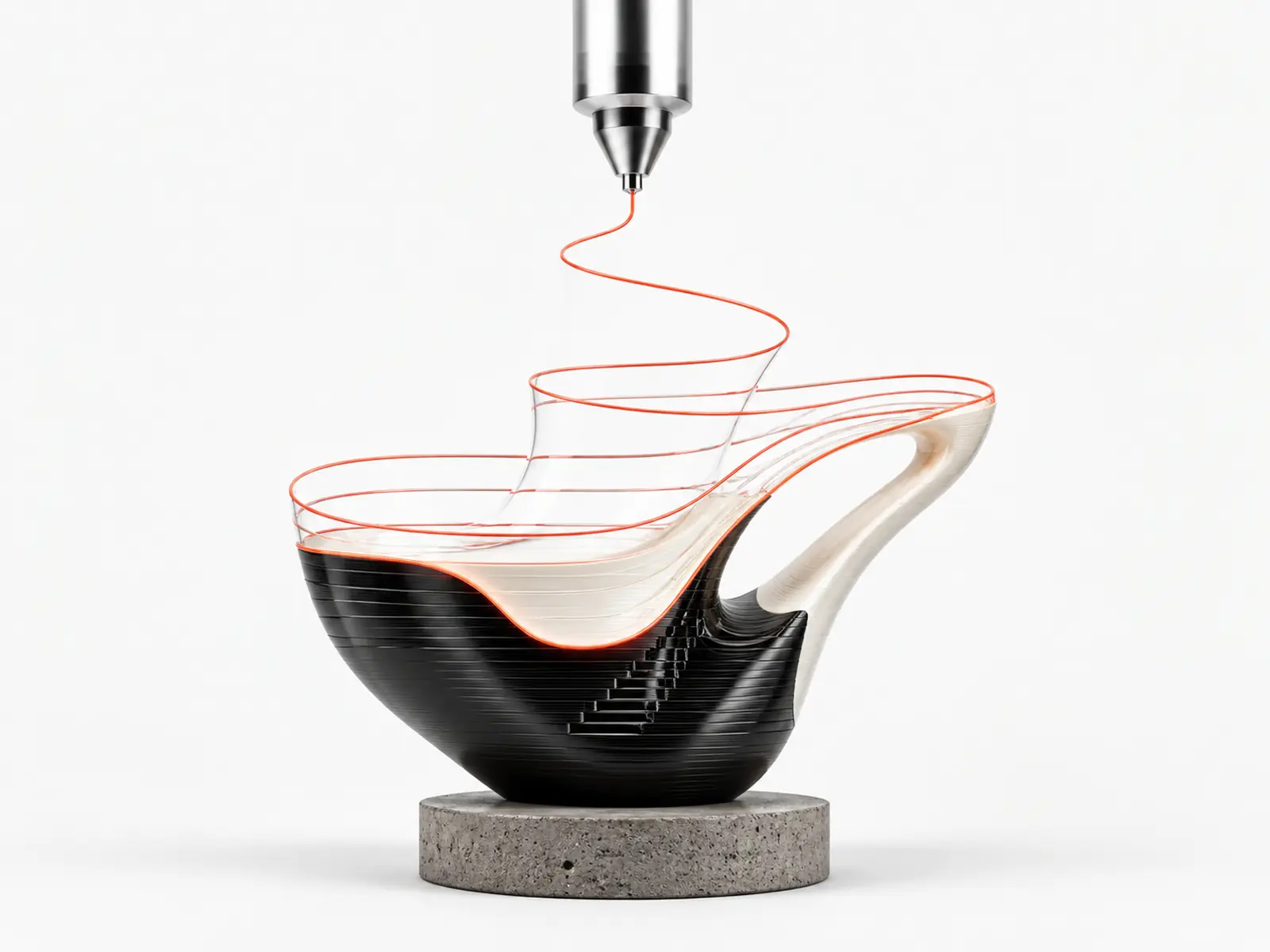
Probably not. But nearly everyone may eventually use something that was printed for them.
The distinction between ownership and access is the most useful way to think about the future of 3D printing. We often imagine new technologies by placing one machine in every home. Yet many important technologies become ubiquitous through infrastructure rather than personal ownership. Most people do not own an industrial sewing machine, commercial press, or CNC mill, but their lives are shaped by what those machines produce.
3D printing may follow a similar path.
3D printing has already moved beyond novelty
The FDA defines 3D printing as the creation of an object from a digital file by adding successive layers of material. Its official 3D-printing overview lists real medical applications including implants, surgical instruments, dental restorations, and external prosthetics.
NASA sent a 3D printer to the International Space Station in 2014. The agency’s account of the experiment explains how in-space production is being studied as a way to reduce the need to launch every possible tool or spare part in advance.
These are facts about present applications. They do not mean that household adoption is inevitable. They show something more important: additive manufacturing is useful when customization, unusual geometry, limited inventory, or distance makes traditional manufacturing inefficient.
Why a printer in every home sounds plausible
Home printers offer an appealing promise. A broken clip, custom drawer insert, replacement knob, or personalized accessory could become a downloadable file rather than a product shipped across the country.
Additive manufacturing can also avoid dedicated tooling for every variation. The U.S. Department of Energy’s additive-manufacturing overview describes design flexibility and the potential to reduce material waste compared with some conventional processes.
For creators, the attraction is even clearer. A designer can move from digital model to physical prototype without ordering a large production run. A small brand can test scale, proportion, and customer response before committing to inventory.
But convenience depends on more than the printer.
A 3D printer is not yet a microwave
A microwave receives a standardized product and performs a familiar task. A 3D printer sits inside a longer chain: the object must be modeled or downloaded, checked, prepared for a particular process, paired with an appropriate material, printed successfully, and often cleaned, cured, sanded, or assembled.
The outcome also matters. A decorative object and a load-bearing replacement part do not carry the same risk. ASTM’s additive-manufacturing standards program covers terminology, machine calibration, process performance, and end-product quality because reliable production requires more than a plausible-looking file.
Safety is another barrier to completely frictionless home use. NIOSH’s guidance for makerspaces, schools, and small businesses addresses emissions from printer-and-filament combinations and recommends controls such as proper ventilation and filtration.
Printers will become easier to use. Materials and software will improve. But physics, maintenance, and responsible operation will not disappear.
Access may spread faster than ownership
Fact: No authoritative evidence currently establishes that universal household ownership is approaching.
Forecast: Access to 3D printing is likely to become far more common than personal ownership.
The next decade may bring more print bureaus, retail production counters, school and library makerspaces, shared neighborhood studios, and brand-operated production networks. Consumers may customize an item online while a vetted facility handles material selection, calibration, and finishing.
For frequent makers, artists, repair specialists, and product designers, owning a printer can make sense. For a household that needs one replacement part every few months, a trusted local or on-demand service may be more practical.
The future could therefore resemble cloud computing: the capability becomes widely available even though most users never own the underlying machinery.
What this could change for brands
If local production becomes more reliable, a product may no longer be only a finished object in a warehouse. It could also be a controlled digital file, a material specification, a license, a personalization system, and a visual set of instructions.
That is a forecast, not a description of today’s entire market.
It could shift e-commerce from selecting among fixed inventory toward configuring what will be made. Brands may offer authorized replacement components, regionally produced accessories, or products adapted to a customer’s measurements. Digital and physical products could become two versions of the same design system.
Sustainability should not be assumed. Printing locally may reduce some shipping and inventory, while failed prints, energy use, difficult-to-recycle materials, and unnecessary objects can create new waste. The environmental result will depend on the full lifecycle, not the word “additive.”
So, will everyone own one?
Our forecast is no—not in the next decade, and perhaps not ever.
But 3D printing itself may become almost invisible: embedded in medicine, aerospace, repair, product development, fashion accessories, interiors, and localized manufacturing. People will encounter the outcome without thinking about the machine.
For brands, the opportunity is not simply to turn products into printable files. It is to make the entire experience coherent—from digital preview and customization to material, packaging, instructions, and final physical form.
RemoteCD helps emerging ideas tell one connected visual story. In an on-demand manufacturing economy, that cohesion will matter as much as the object being printed.
Sources & further reading
- FDA — 3D Printing of Medical Devices
- FDA — Medical Applications of 3D Printing
- NASA — 3D Printing: Saving Weight and Space at Launch
- NIST — Machine learning for additive manufacturing
- NIOSH — Approaches to Safe 3D Printing
- ASTM — Additive manufacturing standards
- U.S. Department of Energy — Additive manufacturing overview